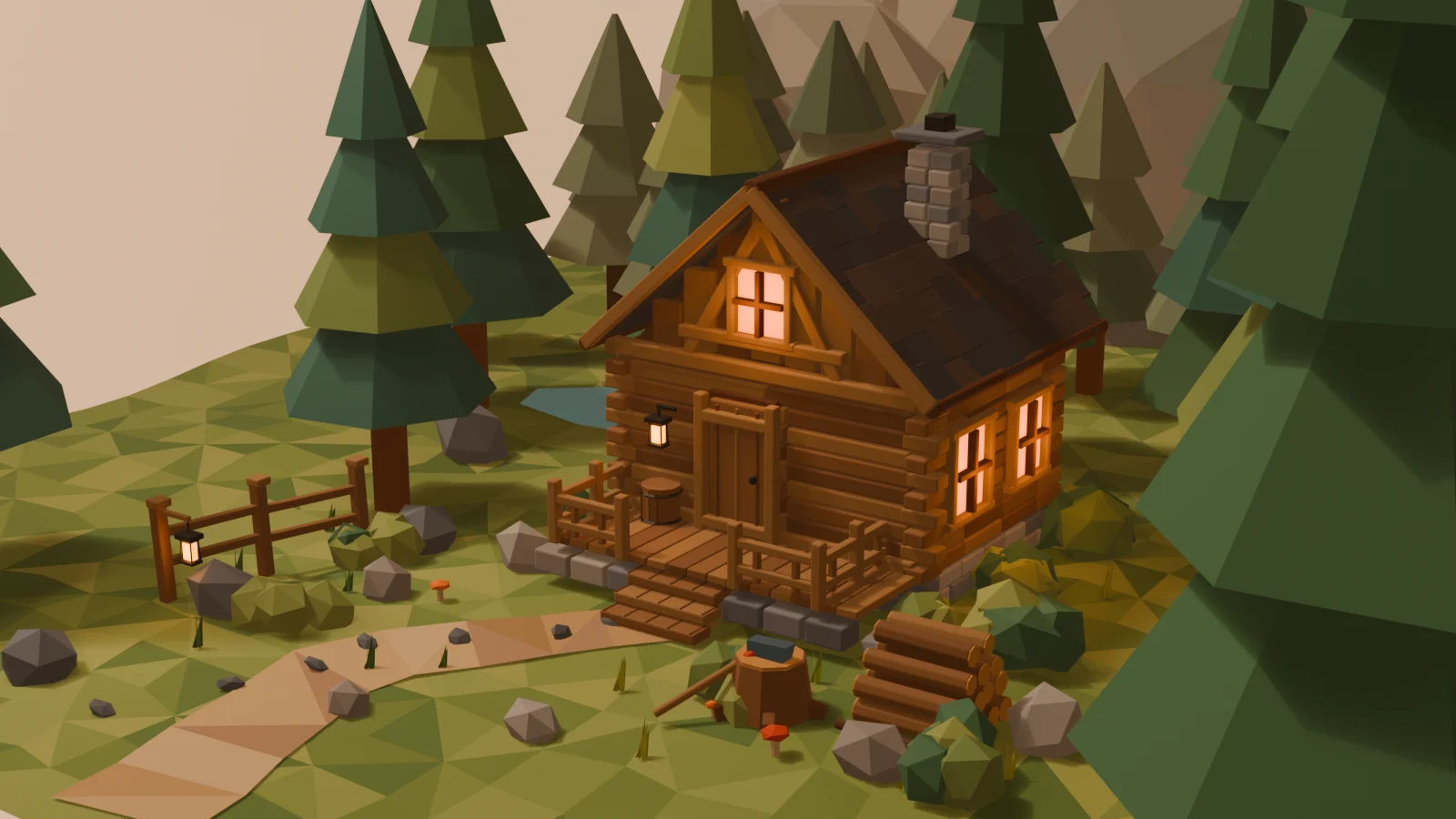
One image in.
Fifteen Blender scenes out.
Same cabin. Same one-line brief. Fourteen GPT‑5.6 configurations across Luna, Terra and Sol, plus GPT‑5.5 as a baseline.
GPT‑5.6 raised the one-shot floor. Ultra made visual feedback part of the loop.
- 15 / 15
- finished scenes
- 3h 16m
- end-to-end runtime
- 24.68M
- reported tokens1
- 2:07
- fastest complete run
Auto rotating · Drag to take controlLive 3D · Drag to explore
Drag to orbit · Pinch or scroll to zoom
Static preview
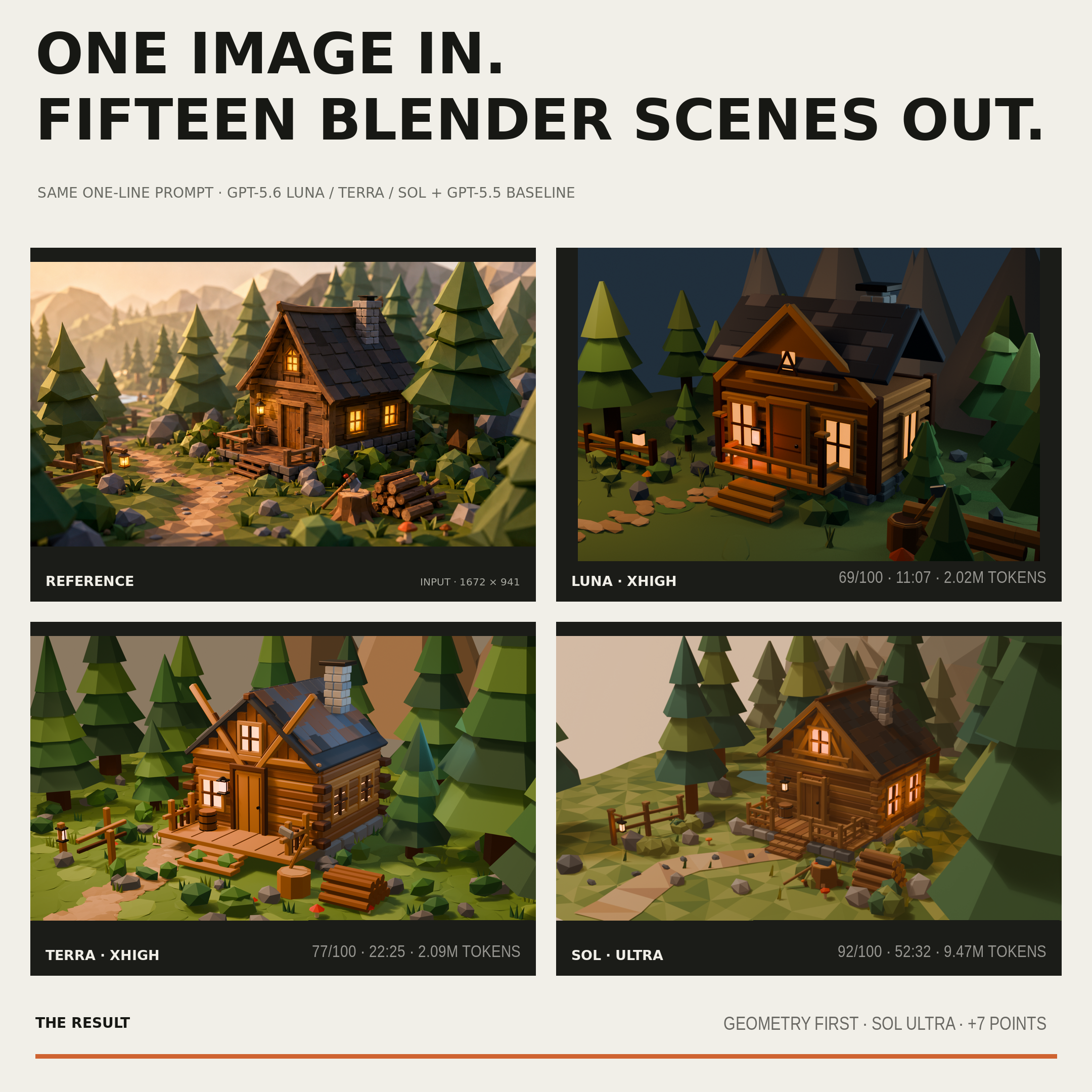
Sol Ultra won the geometry-first benchmark by seven points. Sol xhigh used 29% of its tokens and 31% of its time.
01 / Setup
A deliberately under-specified test.
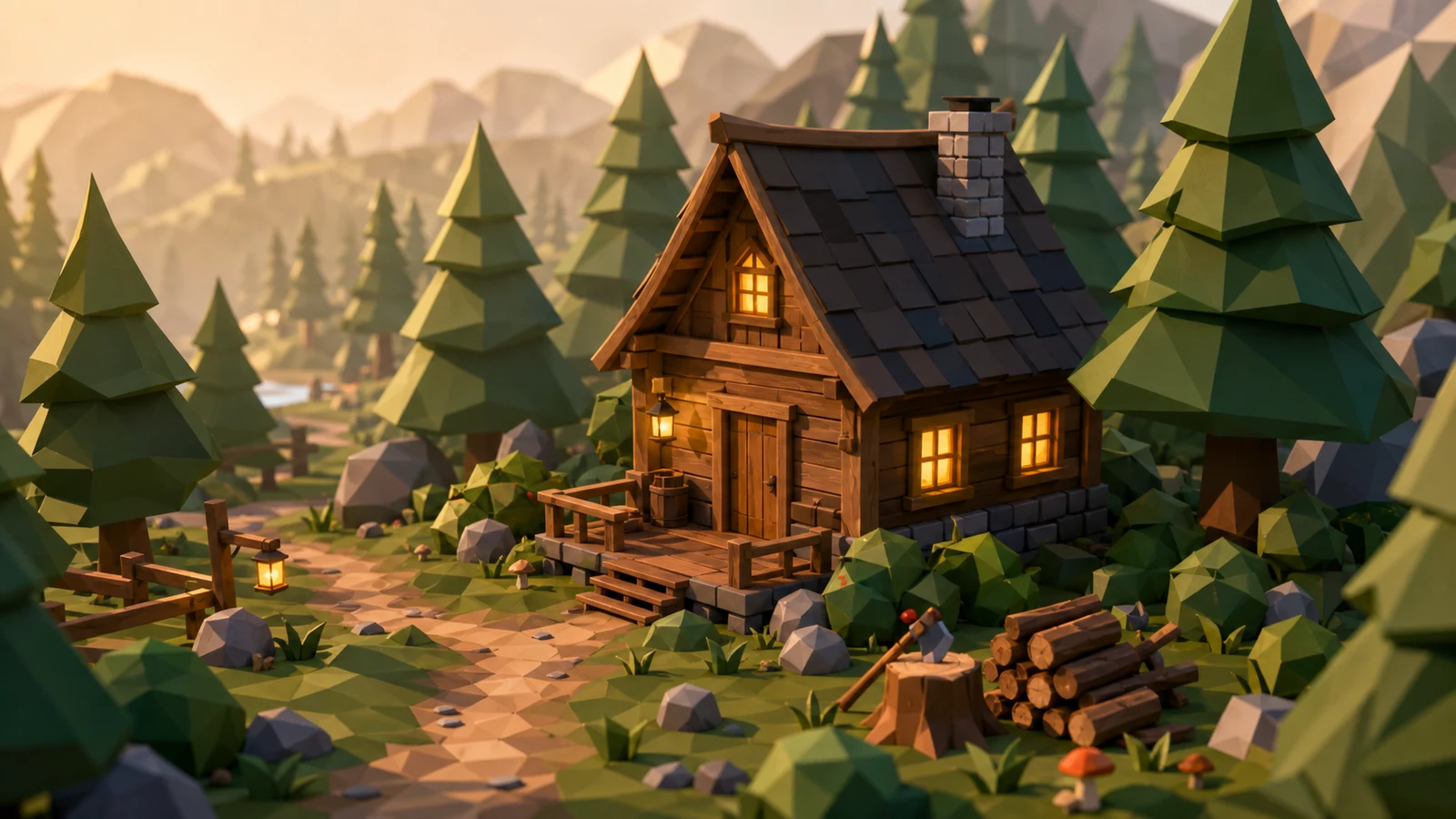
The models received a picture, not a scene graph, asset pack, or modeling recipe. The folder name was the only variable in the prompt.
Exact prompt
“Build this in Blender. Create and work in a subfolder named {gpt-5.6-sol-ultra}.”
The animated token is {run}. The prompt stayed identical.
- Input
- One byte-identical 1672 × 941 PNG
- Environment
- Codex, Ubuntu, Blender 5.0.1
- Deliverable
- Editable .blend, Python builder, final render
- Coverage
- low / medium / high / xhigh; ultra on Sol and Terra
- Runs
- One primary attempt per configuration
02 / Outputs
Every render, as delivered.
Images are re-encoded for the web; native framing is preserved with no crop or retouch. Open any result for its full audit, scene complexity and source files.
Showing 15 outputs
03 / Scoreboard
Geometry first. Then the image.
The weighted score adds four manual ratings in priority order. Structural failures receive the largest penalty, while resemblance is deliberately the smallest component.
Geometric logic
Coherent roof, shell and foundation; grounded objects; clean attachments; no unintended intersections or hovering parts.
Composition
Readable hierarchy, framing, camera, leading path, balance, useful occlusion and layered scene depth.
Visual finish
Lighting hierarchy, exposure, color depth, material readability, atmosphere and overall beauty.
Input match
Cabin proportions, scene contents, camera, forest, path, props, palette and mood relative to the reference.
Total = 40 + 25 + 20 + 15. Ties break in that same order, beginning with geometry.
Weighted score vs. reported tokens
| Run | Total | Geometry | Composition | Finish | Match | Time | Tokens |
|---|
04 / Findings
What wins when geometry comes first.
The revised ranking rewards scenes that make physical sense before judging framing, beauty and resemblance.
01
Sol Ultra is the clear winner.
It scored 92/100: 38 geometry, 24 composition, 17 visual finish and 13 input match. Sol xhigh reached 85 with 29% of the tokens and 31% of the time, but its flatter amber-olive palette and shallower depth create a visible seven-point gap.
02
The geometry-first rubric changes the podium.
GPT‑5.5 xhigh rises to third because its cabin scores 37/40 for structural logic, despite weaker framing. Terra xhigh lands fourth because crossed braces and protruding roof beams cost geometry points. Terra Ultra falls to seventh because its otherwise attractive house visibly floats above the terrain.
03
Sol Light delivered the best value.
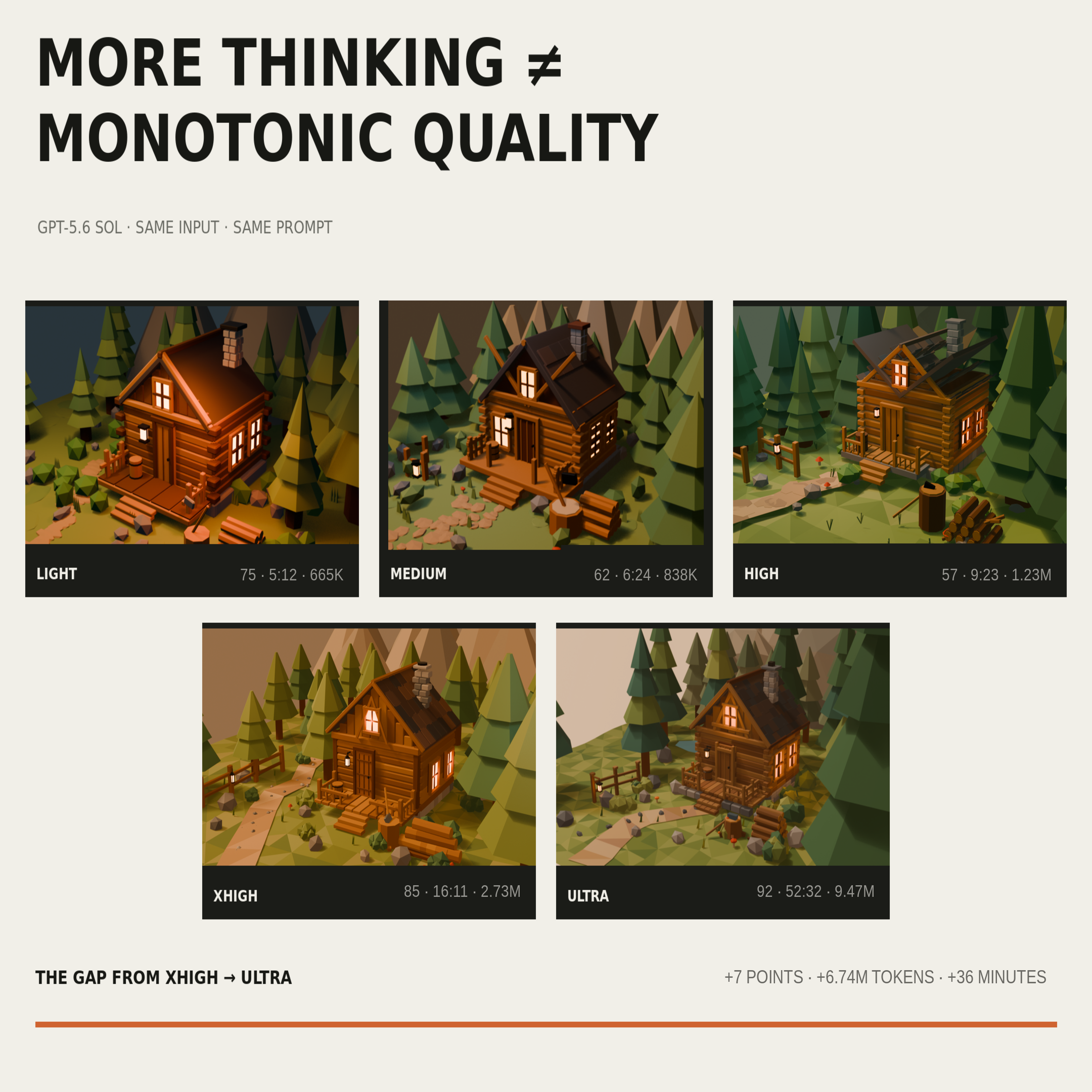
At 665K tokens and 5:12, it scored 75, placed fifth overall and beat ten configurations. Its roof and cabin remain coherent while many more expensive runs spend detail on scenes with broken primary geometry.
04
Thinking effort was visibly non-monotonic.
Sol medium and high broke their roof assemblies. Terra xhigh scored 77 while Terra Ultra scored 70. Luna High reached 74, five points above Luna xhigh despite using roughly one-third of its tokens. More thinking raised the ceiling, but did not guarantee a more logical scene.
05
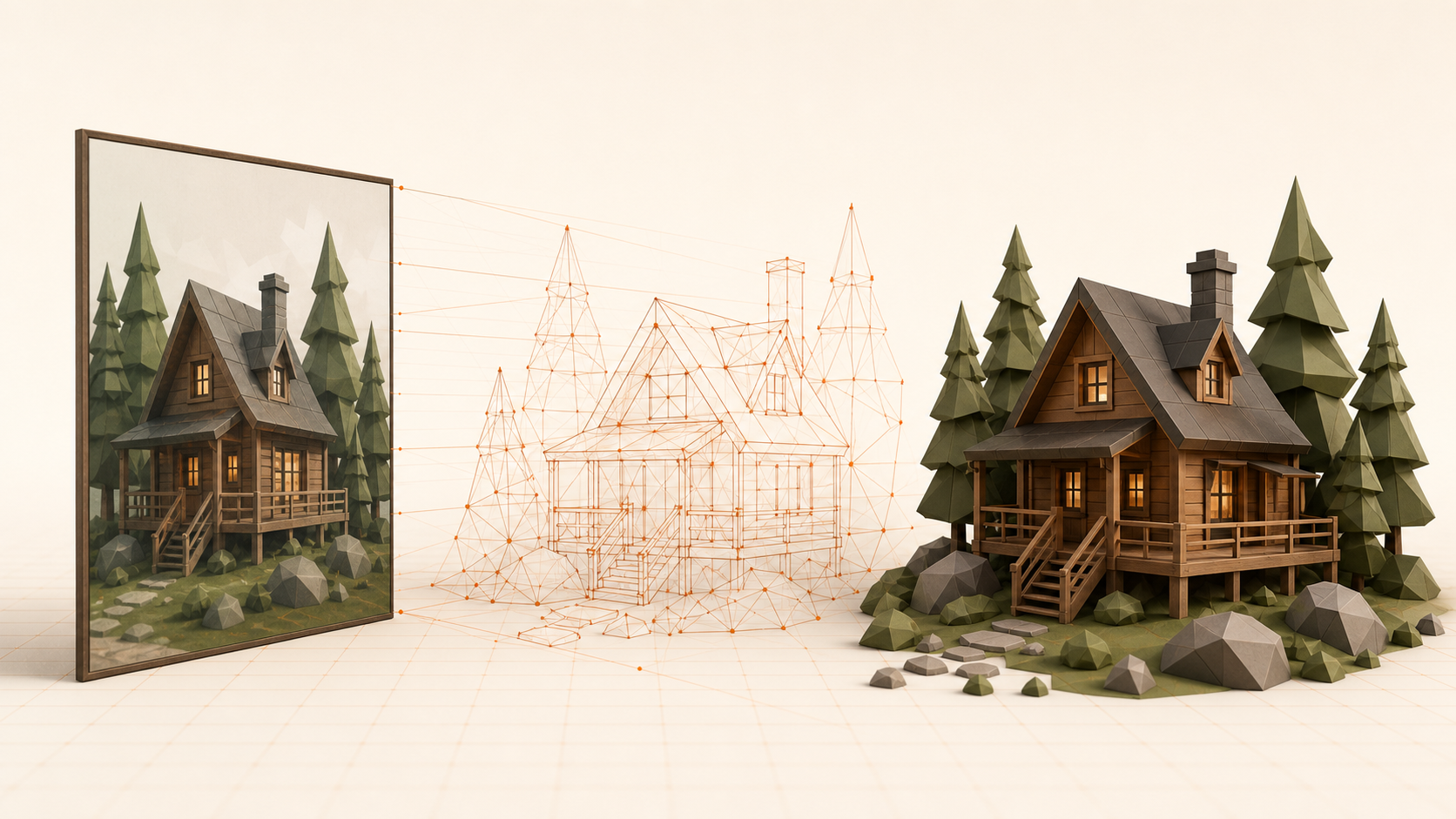
The benchmark is semantic reconstruction, not inverse graphics.
None of the 15 scripts loaded, sampled, calibrated or measured the reference. The agents inferred “cozy low-poly cabin” and hand-built a plausible scene from primitives. That is impressive, but it is a different capability from recovering the pictured 3D scene.
06
GPT‑5.6 raised the one-shot floor.
The broken roof is a structural diagnostic, not a cosmetic detail. Earlier GPT‑5.5 workflows often needed steering when roof panels, rafters and gables separated. In this benchmark, some GPT‑5.6 runs, especially Sol Ultra, got the steep roof coherent in the first autonomous pass. One run per configuration is not a reliability study, but the practical baseline has clearly moved.
07
Ultra can critique the render, not only write the builder.
Its visual feedback loop catches clipped objects, overlaps, lighting balance and whether the scene has the intended feeling. The important loop is geometry to rendered evidence to targeted correction, not simply more procedural detail.
08
Orchestration can become dramatically more token-efficient.
The next workflow is not hand-holding every modeling step. It is giving the model a small number of high-value visual checkpoints so it can propose, render, inspect and correct. Full Blender scenes and larger worlds should become possible with much less token spend. That is the next hypothesis to test, not a claim this single sample proves.
05 / Under the hood
What separated the strong builds.
I reopened every .blend in Blender 5.0.1 and audited the generated Python rather than judging screenshots alone.
Coherent geometry
The best runs modeled a continuous terrain, a tapered path and a dimensionally coherent gable. Weak runs stacked decorative slabs until they looked roof-like.
Composition before detail
Path, fence, woodpile, foreground trees and mountain layers mattered more than raw polygon count. Terra xhigh used the most objects; Sol Ultra still scored higher with fewer.
Lighting hierarchy
Warm local window lights, a broad key and cooler environmental fill created depth. A single orange wash made even detailed scenes read flat.
Recovery mattered
All 15 runs shipped, despite most GPT‑5.6 agents first using a stale Eevee engine enum. The chat histories show diagnosis, patching and re-rendering, not one-shot code generation.
Best implementation
Sol xhigh
Its 777-line builder combined deterministic terrain, reusable modeling helpers, meaningful collections and rich detail in 499 meshes. Sol Ultra was more ambitious; Terra Ultra was more disciplined; GPT‑5.5 was the most software-like standalone tool.
06 / If I had to choose
Four answers for four constraints.
Best overall
Sol Ultra
- Score
- 92
- Geometry
- 38 / 40
- Tokens
- 9.47M
Best value
Sol Light
- Score
- 75
- Geometry
- 34 / 40
- Tokens
- 665K
Practical runner-up
Sol xhigh
- Score
- 85
- Geometry
- 35 / 40
- Tokens
- 2.73M
Fastest finish
Luna Light
- Score
- 46
- Geometry
- 19 / 40
- Tokens
- 230K
07 / Method & caveats
What this test can and cannot say.
The raw renders, editable scenes, generated scripts and machine-readable data ship with this page.
Weighted rubric
Geometric logic 40; composition 25; lighting, color and visual finish 20; accuracy to the input 15. Each total is the sum of four whole-point manual ratings.
Token accounting
Reported total = input + output; cached input is a subset of input and reasoning is a subset of output. Sol and Terra Ultra include marginal child-agent usage. Cached tokens were not counted twice.
Runtime
Elapsed time comes from Codex task_complete telemetry and includes shell work, Blender execution, inspection and self-correction. Runs overlapped on the same host, so it is not a pure inference-speed test.
Dollar cost
These were subscription-backed Codex runs. The local records contain tokens, not a billable API price per model, so tokens are shown as the reproducible cost proxy.
One sample each
This is a capability probe, not a variance study. One render per configuration cannot tell us how often a model reaches the same quality.
No normalization
The agents chose camera, aspect ratio, resolution, Eevee settings and color management. Eight of 15 stayed near 16:9; every Luna output drifted. Those choices are part of the result.
Audit package